
The Griffin Poetry Prize is Canada's most generous poetry award. It was founded in 2000 by businessman and philanthropist Scott Griffin. The awards go to one Canadian and one international poet who writes in the English language. The winning poets receive $65,000 (Cdn) each and an additional $10,000 (Cdn) goes to each shortlisted poet who reads at the annual Griffin Poetry Prize Shortlist Readings in Toronto, Canada.
Philip Mosley, Griffin Poetry Prize 2011 International Shortlist
Philip Mosley is Professor of English and Comparative Literature at Pennsylvania State University. He earned his M.A. in European literature and his Ph.D. in comparative literature from the University of East Anglia. He has translated The Intelligence of Flowers by Maurice Maeterlinck, Bruges-la-Morte by Georges Rodenbach, Tea Masters, Teahouses by Werner Lambersy, and October Long Sunday by Guy Vaes. In 2008 he was awarded the Prix de la Traduction Littéraire by the French Community of Belgium for his translations of Belgian authors into English.
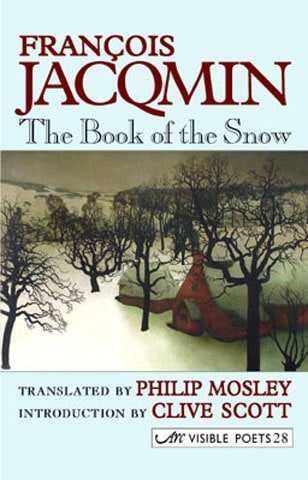
François Jacqmin, Griffin Poetry Prize 2011 International Shortlist
François Jacqmin, acknowledged as one of the foremost francophone Belgian poets of the latter half of the twentieth century, was born in 1929 in Horion-Hozémont in the province of Liège. In 1940 his family fled to England to escape the German occupation. He returned to Belgium in 1948 and rediscovered his native language and literature. His three major volumes of poetry are Les Saisons (1979), Le Domino gris (1984), and Le Livre de la neige (1990). Eléments de géométrie, a volume of prose poems written a few years before his death in 1992, was published in 2005.
Judges’ Citation
“Francois Jacqmin’s The Book of the Snow displays a poetry which is pure, abstract and uncompromising, but also deeply felt, utterly precise, attuned to the complexity of the world. It takes the language of philosophy, of speculation and meditation, and adds to it a rich calm cadence; every image has a real and exact value. The short poems are surrounded with terms which seem to gesture towards saying something which is true and towards something else which is beyond mere truth. The central paradox of Jacqmin’s poetry is the human mind’s need to speak played against a profound suspicion of language. The unmarked snowy fields, the mind before thought, the blank silence that underlies all human expression – these are the slates on which these poems form and disintegrate. The poems in Philip Mosley’s translation are thus filled with a mysterious beauty; they have a sort of shimmering quality.They are poems filled with both the world’s weather and a weather which belongs to language purely and exquisitely shaped and sculpted.”
Summary
An intriguing set of short, deceptively simple poems, The Book of the Snow meditates on the austere beauty and elemental power of the midwinter scene. It is also a subtle, witty, occasionally savage critique of our philosophical and artistic complacency. Mosley’s beautifully modulated translation of the last collection to be published in the poet’s lifetime, makes available to English-language readers for the first time the work of one of Belgium’s foremost francophone poets of the twentieth century.
Note: Summaries are taken from promotional materials supplied by the publisher, unless otherwise noted.
Philip Mosley reads from his translation of The Book of the Snow by François Jacqmin
The Book of the Snow by François Jacqmin, translated by Philip Mosley
From The Book of the Snow
Hounded by the night, the snow pushed the door and advanced to the heart of the abode. It penetrated like those gentle convictions you have in dreams. Then it sat down in the middle of the hearth. Installed in the fold of the flames, it contemplated my thoughts. It was tired of its whiteness, and awaited my compassionate shadow.
Traquée par la nuit, la neige poussa la porte, et avança jusqu’au coeur du logis Elle pénétrait comme ces convictions douces que l’on a en rêvant. Puis, elle s’est assise au mileu de l’âtre. Installée dans le giron des flames, elle contemplait mes songes. Elle était lasse de sa blancheur, et attendait mon ombre compatissante.
The snow is everywhere, and its softness drives the sacred orators to despair. There is no longer a single spot for you to place a metaphor. Its art is so pure that it begets not the pain of a conviction. The hearing is its word. It is in the endless belfry of its whiteness that my finest understatements ring out.
La neige est partout, et sa douceur désespère les orateurs sacrés. Il n’est plus un seul lieu où l’on puisse placer une métaphore. Son art est si pur qu’il n’engendre pas la souffrance d’une conviction. L’ouïe est son verbe. C’est dans le clocher sans fin de sa blancheur que tintent mes plus beaux sous-entendus.
The following are links to other Web sites with information about translator Philip Mosley and poet François Jacqmin. (Note: All links to external Web sites open in a new browser window.)