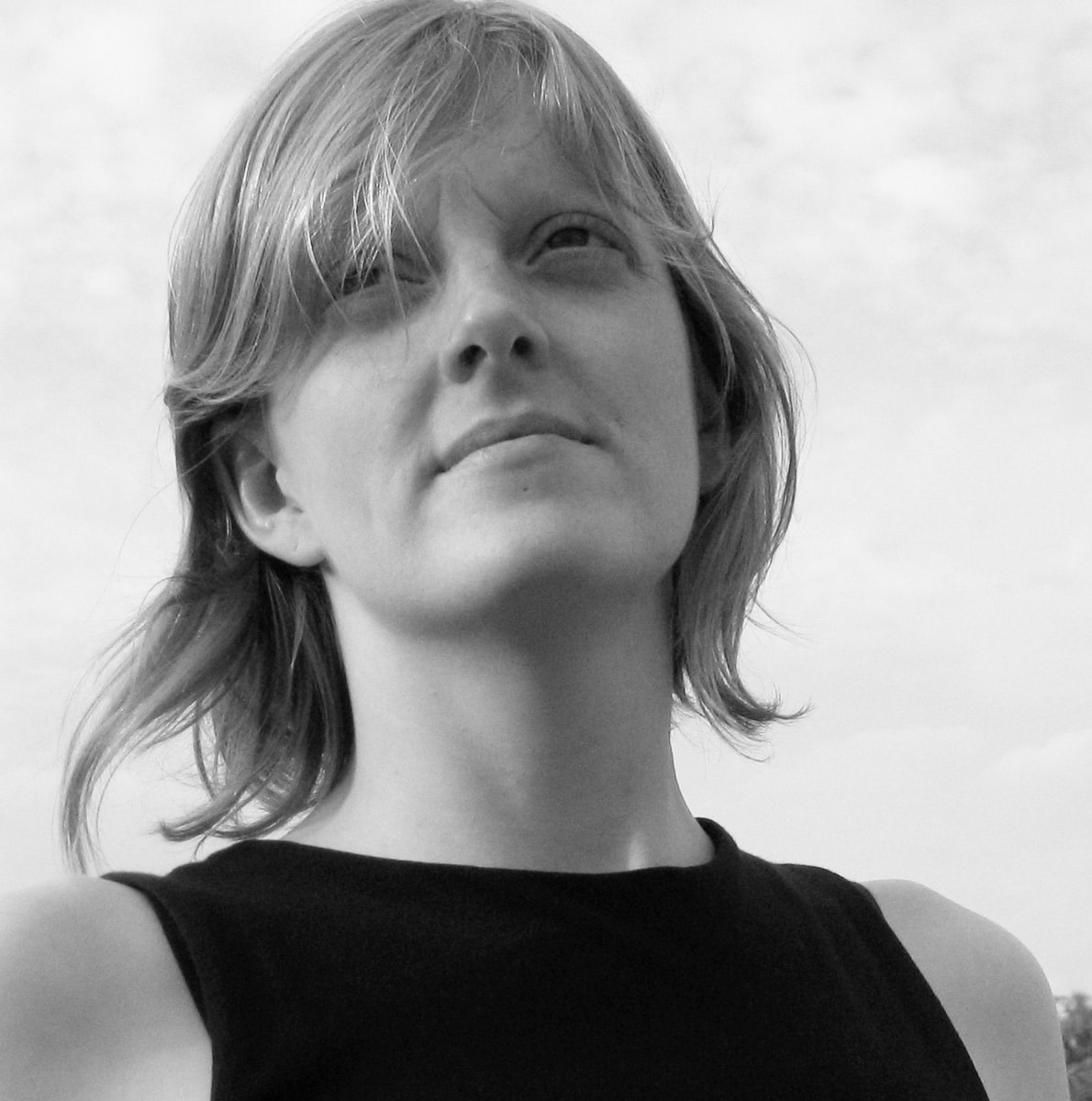
Kate Hall’s poems have appeared in many journals, including The Colorado Review, jubilant, Swerve, The Denver Quarterly, Open City, Verse, LIT and the Boston Review. She has won the Irving Layton Award and the David McKeen Award and travelled on the storied Wave Books poetry bus tour in 2006. She was co-editor of the delirium Press chapbooks and co-hosted the Departure Reading Series in Montreal, where she now lives and teaches at McGill University.
Judges’ Citation
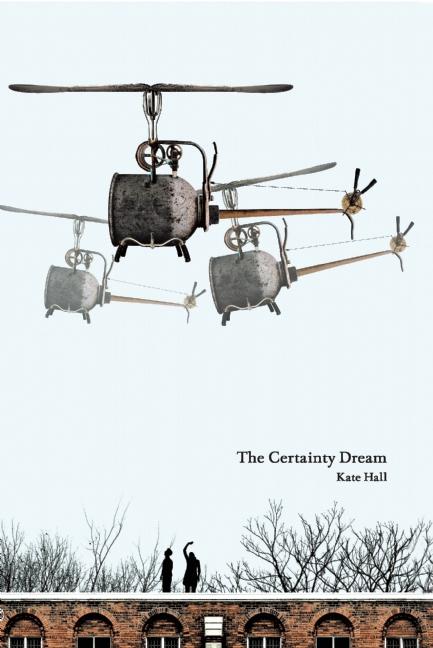
Kate Hall’s book is called The Certainty Dream and it has what appear to be three homemade helicopters on the cover. The helicopters are in fact oil cans lashed to egg beaters and are held together by the good hopes of two tiny humans waving at them from the lower margin of the cover.
We Canadians are an earnest people and we make earnest books. I have done so myself. But every so often in the midst of crafting a particularly earnest sentence I’m struck by that Oscar Wilde feeling – ‘either the wallpaper goes or I do.’ There should be an award, I’ve thought on these occasions, for a person who, from within the confines of our grand funny country, can treat the topics of life, dreams, death, winter and animals without earnestness. Kate Hall’s book is called The Certainty Dream and it has what appear to be three homemade helicopters on the cover. The helicopters are in fact oil cans lashed to egg beaters and are held together by the good hopes of two tiny humans waving at them from the lower margin of the cover. It is a summary image of Kate Hall’s method and mood. What holds a poem together, what holds a dream together, is the mind of some person working within it to make sense, using the available means. Her means include lots of philosophers’ names and sparkly bits of their thought, but these are not decoratively invoked, they are woven into the sense that she makes and the mood in which she makes it. I like the feeling her poems give that as we read them we are amidst an actual process of thought. And that this process takes place, as she says, in ‘the gigantic margin reserved for wrong guesses.
Selected poems
by Kate Hall
I don’t want to see the city through
myself anymore. I imagine an open body
stuck with pins and flags ready
for labelling. The city is a city of constant
sidewalk repairs and household renovations.
If I could lay my hands on the interior walls
I would know enough to miss myself.
The city is a city of streets named
after saints and explorers. On the dock
I am cold. I imagine myself
at an art gallery looking at installations
and not pretending there can be
any sort of understanding.
But somewhere the water
may meet the unseen shore
and someone like you believes
it happens. There
is a line where they touch.
I would like to speak
to that line and have it speak
to me in return.
Copyright © Kate Hall, 2009
Dream in Which I Am Separated from Myself
There must be a method of transport
because there are regulations about the movement
of dangerous goods. You made me
a photocopy. I’ve started worrying about getting
the proper transportation certificate
which requires the inspector’s signature,
which requires believing there is
an inspector with the authority to okay me.
There are moments when a dog will hear
what you cannot. The bark is a warning
at 92 decibels. Because you hear nothing
moving out there, fear is vague and continuous.
Quiet is a command that registers only 7 decibels when
spoken aloud. I read your note about the beauty
of the immune system and the mathematics of the brain.
How would you like me to interpret
this love letter? It weighs next to nothing
and ends abruptly. It’s true, the container
has great aesthetic value but I was really hoping
for a free watch with a rechargeable battery or
at least a better kind of nothingness.
Copyright © Kate Hall, 2009