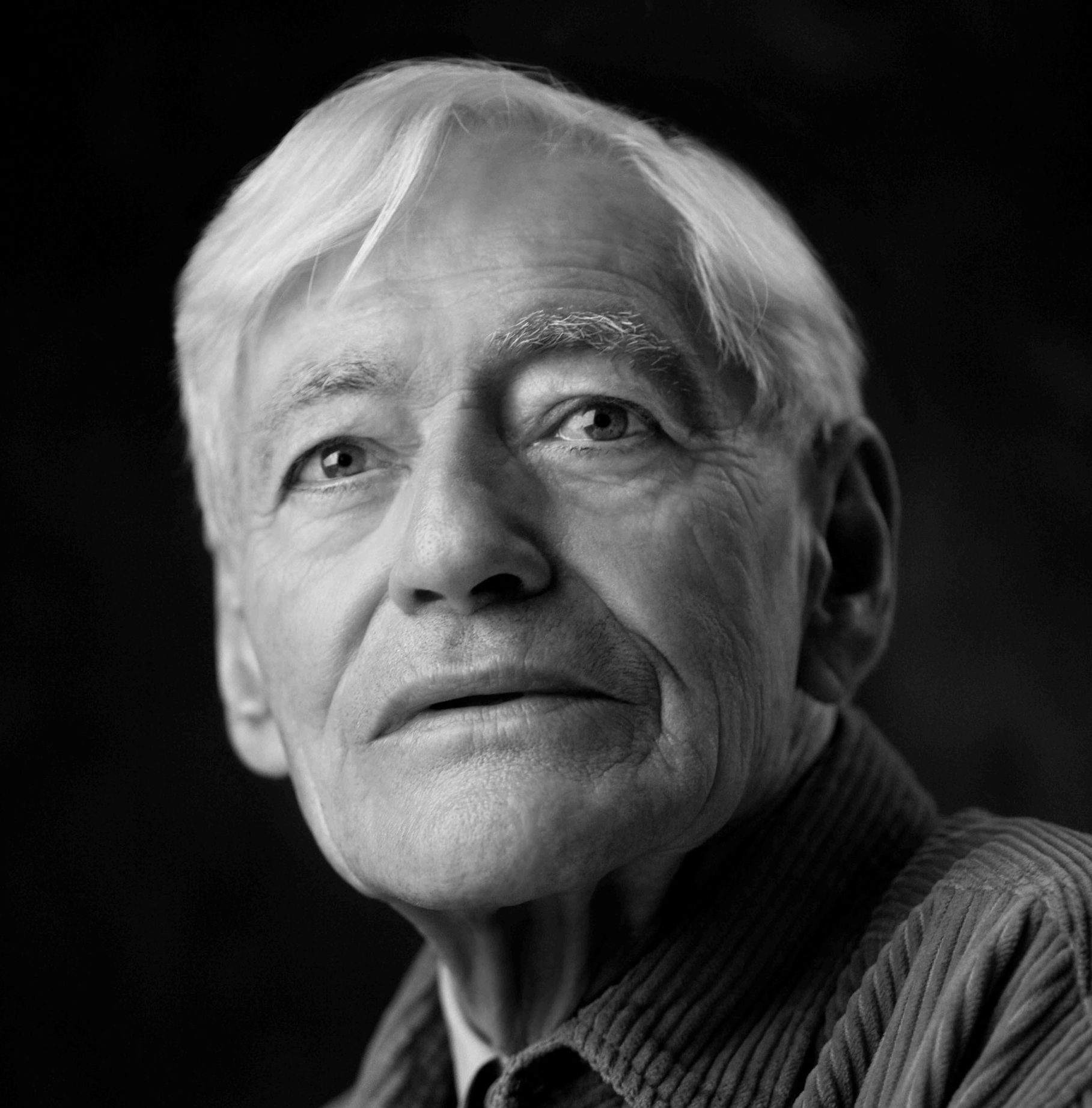
Robin Blaser is one of North America’s most outstanding poets of the postwar period, having emerged from the Berkeley Renaissance of the 1940s and 1950s as a central figure in that burgeoning literary scene. He is Professor Emeritus at Simon Fraser University and has published several books of poems and numerous essays, many of which are included in The Fire: Collected Essays of Robin Blaser (University of California Press, 2006). Blaser established himself as a key figure on the west coast of British Columbia and an important influence among Canadian experimental poets such as George Bowering, Steve McCaffery, bp Nichol, Erín Moure and Daphne Marlatt. Blaser also penned an English and Latin opera libretto entitled The Last Supper. On May 31st, 2006, the legendary poet received our first Lifetime Recognition Award.
We note with great sadness that Robin Blaser died in May, 2009. Numerous moving tributes to him and his work have been published, and we have linked to some of them from here.
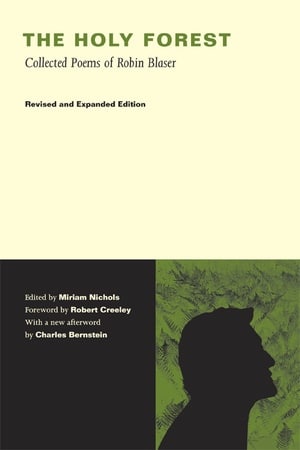
Holy Forest: Collected Poems of Robin Blaser 2008 Canadian Winner
Judges’ Citation
There is an irony in the presumption that the universe contains the ‘collected’ poems of Robin Blaser.
There is an irony in the presumption that the universe contains the ‘collected’ poems of Robin Blaser. Within the five hundred pages of The Holy Forest moves a lifetime’s thought such as we are not used to or prepared for. Whitman was not fooling when he said that a poet, an extraordinary poet, can himself be a cosmos. But as sidereal as Blaser’s lines become, we never forget that the purpose is human living every day inside what is. In a review of an earlier volume with the same title (bravely published in Canada by Coach House and later listed by Talonbooks), Brian Fawcett wrote: ‘His truest poetic instinct is that cosmology is at once humanity’s fundamental pursuit – and the source of our most screamingly funny ironies, misapprehensions and pratfalls.’ Blaser is solemn enough to approach Dante Alighieri as a ‘Great Companion,’ and serious enough to maintain that ‘the truth is laughter’ we might find some afternoon on the darkest pavement.
Selected poems
by Robin Blaser
the Bible is as historical
as you or I
and feathered as our words
fly,
a crow there, a peacock,
a sparrow pecking sidewalk
crumbs.
We both know it takes centuries
to say that,
bumming it,
riding the rails of that railroad,
you and I whistling past
all stops.
8 August 2002
Copyright © 2006 The Regents of the University of California
from Image-Nation 26 (being-thus
‘Where is Abraham buried?’ you ask. Well, in the Kabbalah, God has a terrible time getting Abraham to agree to die. In the Zohar, where Abraham is initiate and David calls God by the name ‘Midnight,’ the splendour is woven in the energies of the Hebrew alphabet, a creation in language that is never still. Now, looking at the three religions of Abraham – Hebrew, Christian, and Muslim – I would say that Abraham, though very much changed since 1700 BCE, is not dead. There’s only so much that a post-Catholic, polytheist exodic can say just now.
for Samuel Truitt
August 1996
Copyright © 2006 The Regents of the University of California
Liveforever
I live in a room named East
on the map of the West at the edge
near the door cedars and alders
mix and tower,
full of ravens first thing each morning,
whose song is
a sharpness
we quarrelled so
over the genius
of the heart
whose voice is capable
they come on horseback
in the middle of the night,
two of them, with a horse for me,
and we ride, bareback
clinging to the white manes,
at the edge of the sea-splash,
burst open,
to divine
the hidden and forgotten source,
who is transparent
where the moon drops out of the fog
to bathe,
but not to us
the retied heart
where the wind glitters
for Ellen Tallman
Copyright © 2006 The Regents of the University of California