
David Harsent has published nine collections of poetry. The most recent, Legion, won the Forward Prize for best collection in 2005 and was shortlisted for both the Whitbread Award and the T. S. Eliot Prize. His Selected Poems (2007) was shortlisted for the 2008 Griffin Poetry Prize.
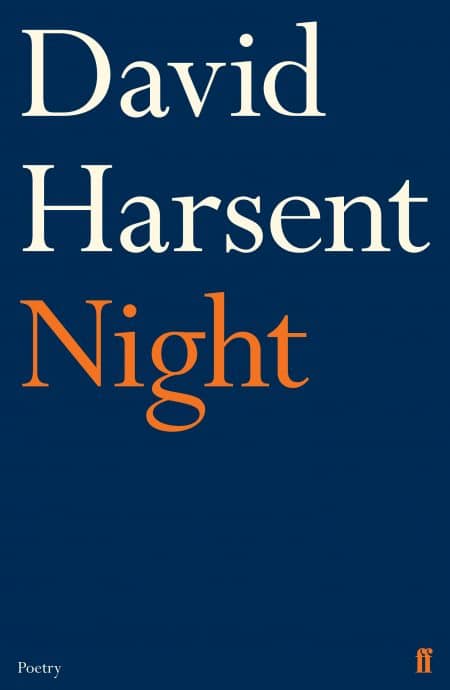

- 2012
- 2008
Judges’ Citation
The four decades’ worth of work spanned by David Harsent’s Selected Poems reveal a writer of enormous accomplishment in whom a constant, restless investigation of new forms, new subjects, new ways of putting together a poem or sequence of poems, is underpinned by a remarkably consistent and powerful poetic sensibility.
Judges’ Citation
David Harsent conducts an examination of the human psyche that is unique in both the unflinchingness of its gaze, and the fabular metaphors it uses to explore dream, terror and hidden impulse.
Selected poems
by David Harsent
In darkness. In rain. Yourself at the very point
where what’s yours bleeds off through the palings
to terra incognito, and the night’s blood-hunt
starts up in the brush: the notion of something smiling
as it slinks in now for the rush and sudden shunt.
A women is laying a table; the cloth
billows as it settles; a wine-glass catches the light.
A basket for bread, spoons and bowls for broth
as you know, just as you know how slight
a hold you have on this: a lit window, the faint
odour of iodine in the rainfall’s push and pull.
Now she looks out, but you’re invisible
as you planned, though maybe it’s a failing
to stand at one remove, to watch, to want
everything stalled and held on an indrawn breath.
The house, the woman, the window, the lamplight falling
short of everything except bare earth –
can you see how it seems, can you tell
why you happen to be just here, where the garden path
runs off to black, still watching
as she turns away, sharply, as if in fright,
while the downpour thickens and her shadow on the wall,
trembling, is given over to the night?
Surely it’s that moment from the myth
in which you look back and everything goes to hell.
Copyright © David Harsent, 2011
A View of the House from the Back of the Garden
Not everything dead is buried in that place
of rapid shadows. They’re all in place, some head-
to-tail or arse-up, some cheek-by-jowl or face
to face (whether or not they were married), some in place
of others who say there’s nothing to be said
and turn the earth at night and know their place.
The markers are blank, since everything’s taken as read
in a place like that. Not everything buried is dead.
Copyright © David Harsent, 2007
Arena
Now rise from the bath, your hair caught up with a peg.
The water peels back from your breasts like the film from
a cooking egg.
You cleanly cleave your arse as you lift one leg
to the edge of the tub and start to work the towel
from ankle to thigh, then into the damson bevel
of your crotch, after which you sit, heel to knee,
on a raffia chair, your quim guerning to a scowl
as you slip your foot into the foot
of your stocking. Next, it’s your face coming free
of the summer dress, as you greet
yourself in the mirror. Here’s how it goes after that:
foundation, powder, eye-
shadow, blusher, mascara,
lipstick pressed to a tissue … that perfectly mute
syllable of love (love, or it could be hate)
that I pick up and pocket to re-read later.
The same summer dress you loosened and dropped with a
clatter
of tiny buttons on tile as I backed you up to the table,
our first night under this roof, and you The Biddable
Spouse, slipping your foot out of the foot
of your stocking … The same table
you cover with a red checkered cloth, setting the bread,
the butter,
the plum preserve, and the best we have of china.
Ur-wife. Wife of wives.
I’m close enough for ambush as you pass with your box
of knives.
Copyright © David Harsent, 2007
Marriage XV
Your book is Summer by Edith Wharton. A smell
off the borders of something becoming inedible.
Between sleeping and waking, almost nothing at all.
There’s music in this, there would have to be: a swell
of strings and bells becoming inaudible,
note by note, before you latch on to it. The girl
in the story won’t prosper, that’s easy enough to tell.
How did night come on like that? The sky is full
of birds, wingbeats in darkness becoming indelible.
Copyright © 2011 by David Harsent, Night, Faber & Faber
The Garden Hammock
Laid-up with all about me
a man could want: a stack of the cross-
hatched notebooks I always use,
a Stabilo pen,
a brand-new thriller that famously stole its plot
from The Spanish Tragedy, vodka,
a pineapple tub
of ice to sap (a little) the bright
fever that loosened my teeth, so I half-expected
to see them drop to the quilt
like sticky Chiclets,
laid-up like that, alone
you might say, but well provided for,
I felt a sleep coming on, so thick
I might have been sleeved in darkness; and next
fell into a dream quicker
than my eyes could close: in fact
I’d already declared for Bel-imperia
and was just getting down
past the damp in the crook of her knee
to those salty, pink petals
of crêpe-de-chine,
when a voice I recognised
had me up and out of there and back to my bed –
a hot, synaptic zip
that almost made me believe I’d woken up
until I saw the tattoo:
a letter to every finger neatly between
the knuckle joints,
as he collared the bottle and turned
a page or two of my notebooks. ‘Just here:
is this lorel or Lorelei? – each syllable sharp
as the detonations in ice
when you pour on vodka – ‘It’s plain
what’s fretting you, but look,
you’ll know it sure enough
when someone you claim to recognise climbs up
out of your bones
and legs it for the door
without so much as a kiss-
my-arse-goodbye (on a darkening day of “rain
moving in from the west”) or even a shred of song.’
Copyright © David Harsent, 2007