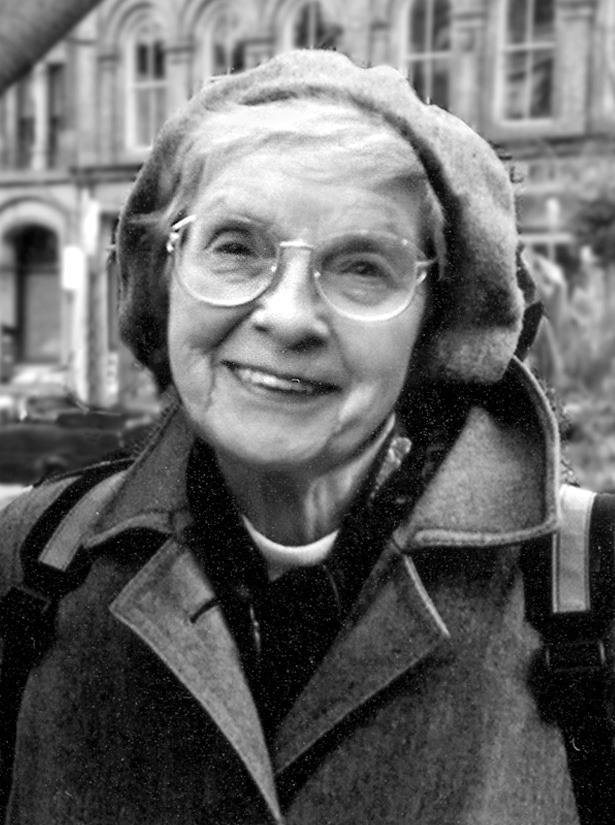
Margaret Avison was born in 1918 in Galt, Ontario, raised in Regina, Calgary and Toronto, where she completed high school in 1936. She continued her studies at University of Toronto earning a B.A. in 1940 and an M.A. in 1963. Her work has been recognized with two Governor General’s Awards for Poetry (Winter and Sun and No Time), by three honorary doctorates and by an officership in the Order of Canada. One of the poems in Concrete and Wild Carrot (‘Prospecting,’ retitled from ‘An-astronomy’) was awarded first place in the category of the Canadian Church Press Awards for 2000. Her other publications include The Dumbfounding, sunblue, Selected Poems, A Kind of Perseverance (prose) and Not Yet but Still. She was most recently honoured with the the Leslie K. Tarr Award for outstanding contribution to Christian writing and publishing in Canada.
The Porcupine’s Quill published a collection of Margaret Avison’s in three volumes under the title Always Now. Read more about the collection on the Porcupine’s Quill Web site. Avison also completed a collection entitled Momentary Dark, published in early 2006.
Margaret Avison died in July, 2007. Numerous moving tributes to her and her work have been published, including ones in the Vancouver Sun and the Globe and Mail.
Judges’ Citation
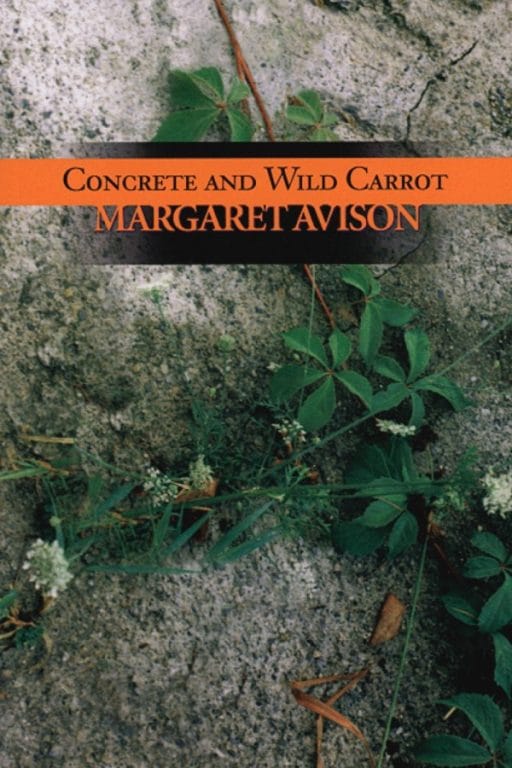
If beauty, as Alfred North Whitehead defines it, is ‘a quality which finds its exemplification in actual occasions,’ and if beauty is more completely exemplified in ‘imperfection and discord’ than in the ‘perfection of harmony,’ then Margaret Avison’s Concrete and Wild Carrot is an occasion of beauty.
If beauty, as Alfred North Whitehead defines it, is ‘a quality which finds its exemplification in actual occasions,’ and if beauty is more completely exemplified in ‘imperfection and discord’ than in the ‘perfection of harmony,’ then Margaret Avison’s Concrete and Wild Carrot is an occasion of beauty. Avison’s poetry is also alive in its sublimity and its humility: ‘wonder, readiness, simplicity’ – the gifts of perception Avison attributes to her Christian faith – imbue every poem in this book with a rare spirit of disorderly love. Margaret Avison is a national treasure. For many decades she has forged a way to write, against the grain, some of the most humane, sweet and profound poetry of our time.
Selected poems
by Margaret Avison
It must have been after a
birthday; at Christmastime
daylight hasn’t the lambency
I remember as part of
the puzzling present somebody
had given me: a scribbler, empty pages, but
not for scribbling in.
Instead of a pencil box there was
a jellyglass set out, with water, and
a brand-new paint brush.
The paper was not pretty.
A pencil-point might in an upstroke
accidentally jab a hole in it.
But, painting it —
as I was told to, with only
clear water, “Behold!”
my whole being sang out, for “see”
would not have been adequate.
The pictures that emerged
were outlines? I remember
only the paper, and the wonder of it,
and how each page was turning out to be
a different picture.
There were no colours, were there?
In the analogy, there are
glorious colours
and, in some way that lacks
equivalents,
deepening colours, patterns that keep
emerging, always
more to anticipate.
For that there is no other process.
Locked in the picture is
missing the quality of the analogy of
morning light
and the delighted holder of the paint-brush
and who gave him the book, and where he found it.
Copyright © 2002 by Margaret Avison, Concrete and Wild Carrot (Brick Books)
Present From Ted
Let’s go to the park where
the dogs and children
cluster and circle and run
under the sombre old trees – they are
hanging on to their swarthing
leaves – while the young
medallioned trees in the early
sun are dancing
among them.
The knapsacked students too
hurtle, always too late, focused
on there, blindingly
swerving out of the now and
here where children and dogs
and a few rather shabby, slow
old ones, straying, move
across the owners, standing with
loose leashes, intent on “their day.”
The benched but sleepless
mothers and nannies, watching,
are quieted here, warmed and fed
by the good old trees and
the shining little ones.
Copyright © Margaret Avison, 2002
Ramsden
The physiologist says I am well over
half water.
I feel, look, solid; am
though leaky firm.
Yet I am composed
largely of water.
How the composer turned us out
this way, even the learned few do not
explain. That’s life.
And we’re in need of
more water, over and over, repeatedly
thirsty, and unclean.
The body of this earth
has water under it and
over, from
where the long winds sough
tirelessly over water, or shriek around
curved distances of ice.
Sky and earth invisibly
breathe skyfuls of
water, visible when it
finds its own level.
Even in me?
Kin to waterfalls
and glacial lakes and sloughs
and all that flows and surges,
yet I go steadily,
or without distillation climb at will
(until a dissolution
nobody anticipates).
I’m something else besides.
The biochemist does not
concern himself with this.
It too seems substance,
A vital bond threaded on an
as-if loom out there.
The strand within
thrums and shudders and twists.
It cleaves to this
colour or texture and
singles out to a rhythm
almost its own, again,
anticipating design.
But never any of us
physiologist or fisherman
or I
quite makes sense of it. We
find our own level
as prairie, auburn or
snow-streaming, sounds forever
the almost limitless.
Copyright © 2002, Margaret Avison, Concrete and Wild Carrot (Brick Books)
Rising Dust
Behind that stone before
it was rolled away
a corpse lay.
There lay all I deplore:
fear, truculence – much more
that to any other I need not say.
But behind that stone I must be sure
of deadness, to allay
self-doubt i.e. so nearly to ignore
the love and sacrifice for our
release; to nearly stray
back into the old
pursuit of virtue.
Once it is clear
it was a corpse that day,
then, then, we know the glory
of the clean place, the floor
of rock, those linens, know the hour
of His inexplicable “Peace;” the pour
— after He went away —
of wonder, readiness, simplicity,
given.
Copyright © Margaret Avison, 2002